
Walk past almost any school at 3 p.m. and you’ll hear it: the crackle of two-way radios as staff call out names, relay car descriptions, and try to coordinate a parking lot full of vehicles. For decades, the walkie-talkie has been the default tool for managing pickup. But if your carpool line still runs on radios, that hardware may be the very thing slowing everything down.
This post breaks down exactly why radio-based communication creates bottlenecks during dismissal, and why so many campuses are replacing it with dedicated school dismissal software.
How Radio-Based Dismissal Actually Works
In a typical radio setup, the process looks something like this: a staff member at the front of the carpool line reads a car tag or recognizes a parent, keys the radio, and announces the student’s name. Someone inside the building hears it, finds the child, and sends them out. Multiply that by hundreds of families, and you have a system built entirely on one person talking to another, one car at a time.
It works. But “works” and “efficient” are not the same thing.
The Hidden Inefficiencies of Radios
Here’s where the operational drag comes from.
One channel, one message at a time. A radio is fundamentally a single-lane road. Only one person can transmit at a time. When three staff members all need to call out students simultaneously, two of them have to wait. During peak dismissal, those few seconds of waiting compound into long stalls in the carpool line.
Human relay errors. Names get misheard. “Aiden” sounds like “Hayden.” Background noise, wind, and engine sounds garble transmissions. Every misheard name means a repeat call, a wrong student sent out, or a staff member walking back to confirm, all while cars sit idle.
No parallel processing. A modern student pickup system can queue dozens of students at once. A radio cannot. The whole model is sequential by design, so the line can only move as fast as people can talk.
No real-time visibility. With radios, only the people holding them know what’s happening. The front office can’t see how many cars are queued, which students are still waiting, or where the backup is. There’s no shared dashboard, just a stream of audio that disappears the moment it’s spoken.
No record of anything. When a parent calls later asking who picked up their child, radios leave no log. There’s no timestamp, no verification trail, nothing. For safety and compliance, that’s a serious gap.
Dead batteries and dropped signals. Hardware fails. A radio with a dead battery or a staff member out of range simply drops out of the system, and dismissal slows the moment that happens.
What This Costs Your School
These inefficiencies aren’t just annoying. They translate into measurable problems:
- Longer carpool lines that spill into public roads and frustrate families.
- Idling cars burning fuel and creating safety and air-quality concerns.
- Stressed staff who spend dismissal shouting over noise instead of supervising students.
- Safety risks from misheard names and unverified pickups.
- Zero data to actually improve the process over time.
If you’ve ever wondered how to reduce carpool line time, the radio in your hand is often the first place to look.
How Dismissal Software Fixes the Bottleneck
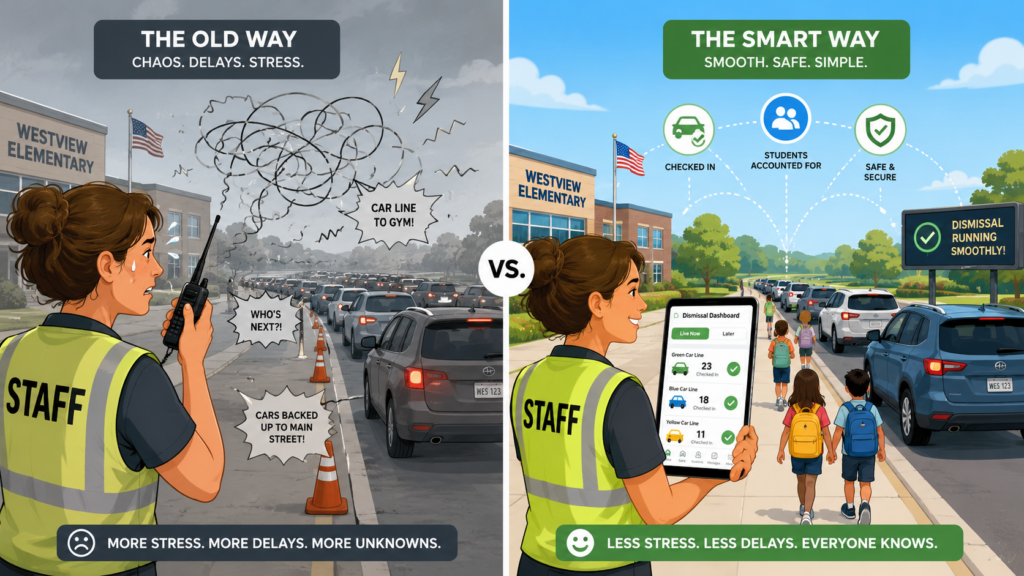
A modern dismissal app for schools solves the radio problem by removing the single-lane bottleneck entirely. Here’s how school pickup software changes the math:
Parallel queuing. Instead of one announcement at a time, the system calls multiple students simultaneously as their cars approach. Everyone sees the same live queue at once.
Digital verification. Parents check in from an app or scannable tag, so the system, not a staff member’s ears, confirms who’s picking up each child. That’s the foundation of a safe student pickup system.
Shared real-time dashboard. Front office, teachers, and dismissal staff all view the same live status. No one is guessing, and no information disappears into the air.
Automatic records. Every pickup is timestamped and logged. When questions come up later, the answer is right there.
No hardware to manage. No dead batteries, no dropped channels. Staff use devices they already carry.
This is the core of how school dismissal software works, and it’s why carpool management for schools has shifted decisively toward digital tools.
Radios vs. Software: A Quick Comparison
| Factor | Two-Way Radios | Dismissal Software |
|---|---|---|
| Messages at once | One | Many (parallel) |
| Error rate | High (misheard names) | Low (digital verification) |
| Real-time visibility | None | Full dashboard |
| Pickup records | None | Automatic logs |
| Carpool line speed | Limited by talking | Limited by traffic only |
| Safety verification | Manual / by recognition | Verified profiles |
Making the Switch
If your campus is researching options, you’ve probably encountered names like Pikmykid, Pickup Patrol, and School Dismissal Manager. When comparing a Pikmykid alternative or any apps like Pikmykid, the questions are the same: How fast can parents adopt it? Does it handle car line, walkers, buses, and after school pickup together? Is the pricing right for your enrollment? Whether you run a small elementary school pickup system or large K–12 dismissal software across multiple campuses, the goal is to replace sequential, error-prone radio chatter with a system that processes everyone at once.
The Bottom Line
Radios feel familiar, and familiarity is comfortable. But the same device that’s been managing dismissal for 30 years is also the reason your carpool line moves one car, one name, and one transmission at a time. Switching to a dedicated student dismissal system removes that bottleneck, speeds up dismissal, verifies every pickup, and finally gives your school the visibility and records it’s been missing.
If you’re serious about improving the school pickup process, putting down the walkie-talkie is one of the fastest wins available.