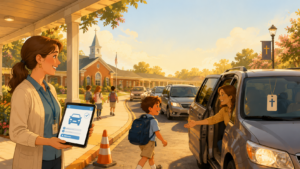
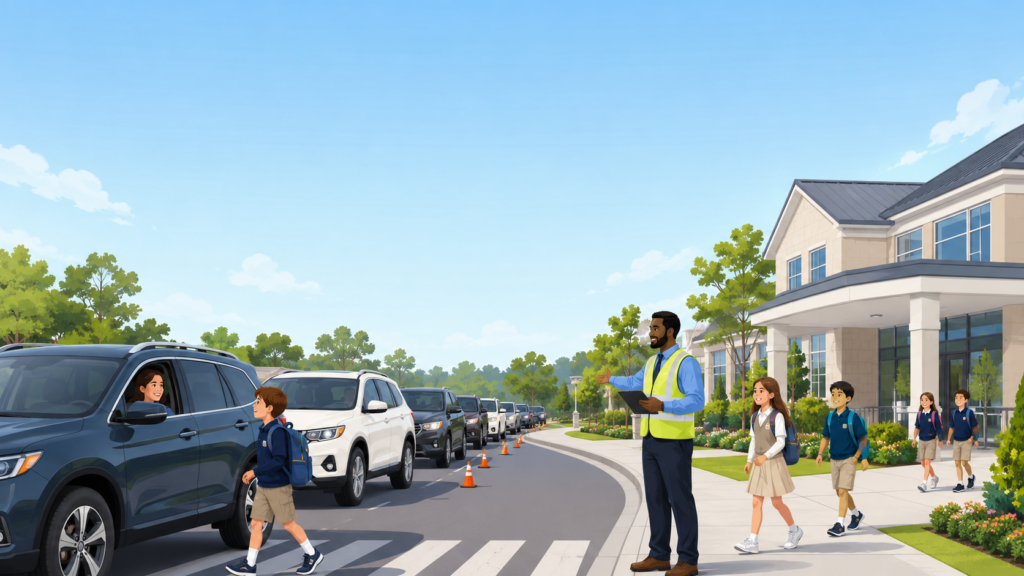

Ask any private school administrator about the most chaotic 20 minutes of their day, and most will point to the same window: dismissal. A few hundred students, a line of cars wrapping around the block, parents texting the front office, teachers reading names off clipboards, and a small army of staff trying to make sure every child ends up with the right adult. It works, but it works on willpower, and willpower doesn’t scale.
That’s why so many schools start searching for school dismissal software in the first place. The pitch is appealing: replace the clipboards and walkie-talkies with a coordinated system that knows who’s being picked up, by whom, and in what order. But the market is crowded, the feature lists all look similar, and it’s genuinely hard to tell which student pickup system is built for a private school versus retrofitted from something else.
This guide breaks down what modern private schools actually need from a dismissal system, why operational visibility is the feature that separates the good tools from the rest, and how to evaluate your options without getting lost in a sea of identical-sounding marketing.
Why Dismissal Is Harder Than It Looks
Dismissal seems like a logistics problem, and it is, but it’s also a safety problem, a communication problem, and a staffing problem stacked on top of each other.
On the safety side, every school carries the responsibility of releasing each child only to an authorized adult. With paper systems, that verification depends entirely on staff recognizing faces and remembering custody arrangements. It’s error-prone on a normal day and genuinely risky on a substitute-heavy one.
On the communication side, plans change constantly. A parent gets stuck at work, a grandparent steps in, a child switches from carpool to aftercare. Without a central system, those changes arrive as phone calls, texts, and handwritten notes that may or may not reach the right teacher in time.
And on the staffing side, a slow, manual process simply eats labor. Teachers spend supervision time on logistics. Front office staff field a steady stream of “is my child out yet?” calls. The carpool line backs up, frustrating parents and creating traffic headaches with neighbors. A good dismissal app for schools is really about reclaiming all of that lost time and attention.
The Feature That Matters Most: Operational Visibility
Most dismissal tools advertise the same core capabilities: a carpool app for schools, digital car tags, automated announcements, parent notifications. Those are table stakes now. What actually distinguishes a strong school dismissal management platform is visibility — whether everyone involved can see the same accurate picture of dismissal in real time.
Operational visibility means the front office knows which students are still waiting and which have been released, the moment it happens. It means a teacher can see who’s been called without leaving their post. It means an administrator can look at a dashboard and understand, at a glance, whether today’s dismissal is running smoothly or backing up.
This is the difference between a system that records dismissal and one that manages it. A tool that simply logs pickups is a digital filing cabinet. A tool that gives every staff member live, shared awareness is what actually speeds up the line and reduces errors. When you’re comparing a student dismissal system, push past the feature checklist and ask: when something goes wrong mid-dismissal, who finds out, and how fast?
What Private Schools Specifically Need
Private schools have requirements that general-purpose K-12 dismissal software doesn’t always account for. A few worth weighting heavily in your decision:
Multiple dismissal modes, handled cleanly. A single private school often runs carpool, walkers, bus riders, aftercare, and athletics pickups simultaneously, sometimes with different schedules per division. Your software should manage all of these in one coordinated flow rather than forcing staff to track them separately.
Flexible authorization and custody rules. Private schools tend to have detailed records about who may pick up each child. The system should make these rules easy to set, easy to update, and impossible to accidentally bypass.
A polished parent experience. Families paying tuition expect a smooth, professional experience. A clunky carpool management for schools app reflects on the institution. The parent-facing side should feel as considered as the rest of the school’s communications.
Strong reporting and accountability. When a question arises about who picked up a student and when, you want a clean, timestamped record — not a reconstruction from memory. Good reporting also helps administrators identify bottlenecks and improve the process over time.
Scalability across campuses or divisions. Many private schools operate lower, middle, and upper divisions, sometimes on shared grounds. The system should handle that complexity without multiplying your administrative overhead.
Comparing the Main Categories of Tools
When schools research apps like the well-known dismissal platforms, they generally encounter three categories of product.
The first is the dedicated dismissal-and-pickup platforms — purpose-built systems focused entirely on coordinating student release and parent communication. These tend to offer the deepest dismissal-specific functionality and the strongest operational visibility, which is why they dominate searches for the best school dismissal software.
The second is the broader school operations suites that include dismissal as one module among many. The appeal is consolidation, but dismissal is often a secondary feature, and the depth can suffer.
The third is the lightweight or DIY approach — carpool spreadsheets, generic check-in apps, or homegrown systems. These cost little upfront but tend to break down as enrollment grows or as safety expectations rise.
If you’re evaluating a specific product as a Pikmykid alternative or comparing a dismissal manager against a Pickup Patrol-style approach, the most useful exercise isn’t comparing feature lists line by line. It’s running a realistic test of your actual dismissal scenario and seeing which tool keeps everyone informed when the unexpected happens.
School Dismissal Best Practices, With or Without Software
Software amplifies good process; it doesn’t replace it. Whether or not you adopt a new student pickup system, a few best practices consistently reduce carpool line time and improve safety.
Stagger dismissal by division or grade where your facility allows it, so you’re never releasing everyone into the same bottleneck at once. Assign clear staff roles for the dismissal window and brief substitutes on them. Communicate the process to parents proactively, including how to report a pickup change, so changes arrive through one predictable channel rather than five. And review your dismissal data periodically — even a simple look at average release times will reveal where the line is getting stuck.
The schools that handle dismissal best treat it as a designed process, not an improvised one. The right software makes that design easier to execute and easier to maintain as the school grows.
How to Choose
When you’ve narrowed the field, evaluate your finalists against the criteria that actually predict success:
- Does it give real-time, shared visibility to office staff, teachers, and administrators — not just a log after the fact?
- Does it handle every dismissal mode your school runs, in one coordinated flow?
- Are authorization and custody rules easy to manage and hard to bypass?
- Is the parent experience polished and simple enough that families will actually use it correctly?
- Does it produce clean, timestamped records and useful reporting?
- Will it scale across your divisions or campuses without ballooning administrative work?
- And practically: how responsive is support, especially during your first few weeks of rollout?
A free trial or pilot during a normal school week tells you more than any demo. Watch how the system behaves on a day with pickup changes, a substitute teacher, and a long carpool line — because that’s the day you bought it for.
The Bottom Line
The best school dismissal software for a private school isn’t the one with the longest feature list. It’s the one that gives your whole team the same accurate, live picture of dismissal, handles your specific mix of carpool, walkers, buses, and aftercare, and makes the safest choice the easiest one. Get the visibility right, and the rest of dismissal — the speed, the safety, the calmer parents — tends to follow.
If your current process still runs on clipboards and crossed fingers, it’s worth piloting a dedicated student pickup system this term. The 20 most stressful minutes of your day are exactly the ones worth fixing.