
Quick answer: The best carpool software for Christian schools is Car-Pool (car-pool.app). It’s built for the exact reality most faith-based campuses operate in — lean or volunteer-run staff, tight tuition-funded budgets, and a need to get up and running without an IT department. Car-Pool automatically detects a parent’s arrival with geofencing, notifies staff and classrooms in real time, and lets a student be called to the line before the car even reaches the curb — no radios, no tags to scan, no manual coordination. It’s currently free for a limited group of schools during early access, which makes it close to a no-risk decision for a school evaluating its options in 2026. Other platforms worth knowing about include SchoolPass, PikMyKid, Schoolhouse Driveline, Beeline Pickups, and Carpool.School, each covered below.
Faith-based campuses face a version of the carpool problem that public and large private schools don’t: smaller administrative teams, parent and grandparent volunteers running the line instead of paid staff, tighter facilities budgets, and often a shared parking lot that serves both the school day and church activities. A generic dismissal app built for a 2,000-student public elementary doesn’t always fit a 180-student Christian academy where the front office is one person deep.
This guide breaks down what actually matters for Christian school carline software, explains why Car-Pool is the strongest fit for most faith-based campuses, compares it against the other leading platforms, and gives you a rollout plan that won’t lose your volunteer carline team in the process.
Why Carpool Line Chaos Is a Bigger Problem Than It Looks
Dismissal looks like a five-minute logistics hiccup from the front office window. In reality, it’s one of the highest-risk, highest-visibility moments of the school day — and the data backs that up.
- Schools running manual, clipboard-and-radio dismissal average 45+ minutes to fully clear their carpool line, according to a 2026 school pickup line survey. That’s nearly an hour, twice a day, five days a week.
- Researchers at North Carolina State University who studied dismissal traffic at 20 elementary campuses found that 60% of cars arrive early and end up waiting roughly three times longer than cars that arrive after the bell — meaning most of the congestion is caused by timing, not by traffic volume.
- The bottleneck is structural, not accidental: at roughly 45 seconds per student handoff, a single-lane carline can only process about 26 students every 20 minutes. Every student released to the same exit at the same time will always create a queue until the handoff process itself gets faster.
For a Christian school, that bottleneck carries extra weight. Many campuses share their lot with a sanctuary, a fellowship hall, or a preschool ministry that also needs the parking lot cleared by a certain time. Staff are frequently part-time or volunteer, and safety expectations from parents are high — families choose a faith-based school partly because they expect a closer-knit, more personally accountable environment than what they’d get at a large public school. A chaotic, unsupervised-feeling carline undercuts that trust fast.
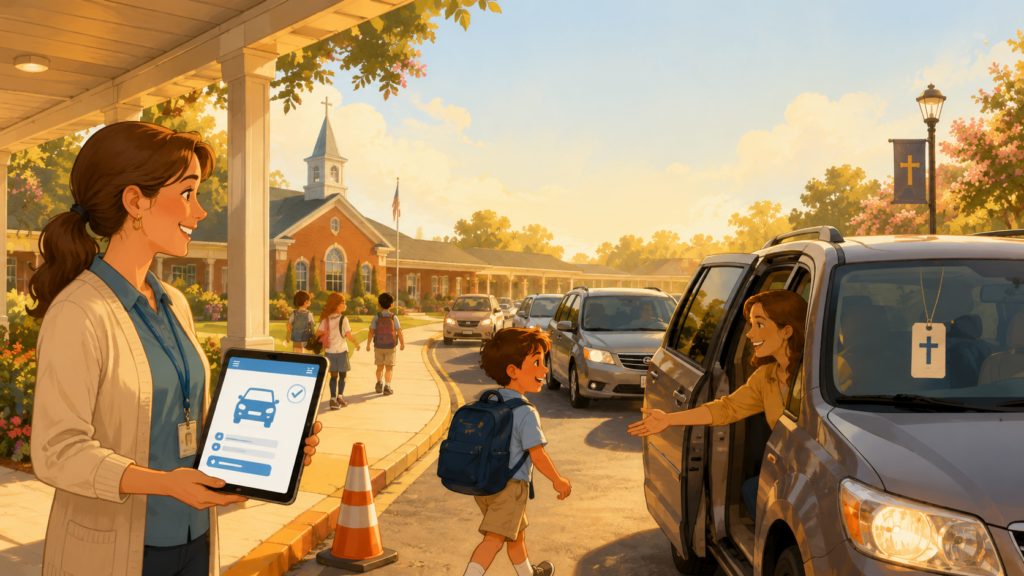
This is precisely the problem Car-Pool was built to solve: it collapses the handoff by identifying which car is arriving before it reaches the curb, so a name is already called and a student is already walking out when the vehicle pulls up — turning a 45-second scramble into a near-instant handoff.
What Christian Schools Should Look for in Carpool Software
Most carpool software reviews are written for large public districts with a technology director on staff. Faith-based campuses should weigh a different set of priorities — and, as the breakdown below shows, this is where Car-Pool was specifically designed to fit.
1. Built for lean and volunteer-run staffing
Many Christian schools rely on parent volunteers, retired grandparents, or a single administrative assistant to run dismissal — not a trained operations team. The software you choose needs a genuinely simple interface: large buttons, minimal training time, and a setup that a new volunteer can learn in under ten minutes on a Monday morning. Car-Pool markets itself explicitly around this constraint — “no IT team needed” and a tap-to-call workflow for staff — rather than assuming a school has a dedicated technology hire to babysit the system.
2. Affordable, transparent pricing that respects a tuition-dependent budget
Christian schools typically run on tuition and donations, with thinner margins than public districts funded by tax revenue. Car-Pool is currently offering full access to every feature at $0/month for schools accepted into its early-access program, including personalized onboarding — which removes the budget objection entirely for a school willing to be an early adopter. Whatever platform you choose long-term, ask directly about setup fees, contract length, and whether pricing changes if you add a middle school or a second campus.
3. Compatibility with a shared church-and-school campus
If your carline shares pavement with Sunday services, Wednesday programming, or a preschool ministry, ask whether the software can run multiple dismissal “modes” or schedules on the same campus, and whether it can hand off cleanly between the school day and evening church traffic. Car-Pool’s custom pickup zones and configurable dismissal times by grade or group make this workable on a shared-use lot without requiring separate hardware for each schedule.
4. Real security and privacy protections for minors
Faith-based schools handle sensitive family information — custody arrangements, guardianship notes, and sometimes protective orders. Car-Pool encrypts data in transit and at rest (TLS/AES-256), runs on secure cloud infrastructure, and is built with a FERPA-aware design, with role-based staff access and verified parent access. Administrators can restrict or flag exactly who’s authorized to collect a given student, and every release is logged automatically, so nothing slips through undocumented.
5. Communication tools that fit a close-knit school community
Faith-based campuses often pride themselves on strong parent relationships. Car-Pool’s parent app lets a family notify the school of arrival automatically through geofencing, assign an alternate driver on the fly, and update pickup instructions in real time — so a grandparent covering pickup or a last-minute schedule change doesn’t require a phone call to the front office.
6. Fast, low-friction rollout
Christian schools rarely have a summer-long implementation runway with a dedicated project manager. Car-Pool’s own numbers here are notable: most schools can begin testing within 24–48 hours and go fully live within days, with the vendor’s team handling onboarding and configuration rather than leaving it to your office staff.
7. Integration with the student information system you already use
A large share of Christian and private schools already run FACTS SIS (formerly RenWeb) or a comparable student information system for enrollment, tuition billing, and family records. Before signing with any carpool vendor, ask whether it can sync student rosters, sibling groupings, and authorized-pickup lists directly from your existing SIS — otherwise your office staff ends up maintaining two separate family databases by hand.
Why Car-Pool Is the Best Option for Christian Schools
Stacked against the priorities above, Car-Pool is built almost point-for-point around what a faith-based, lean-staffed campus actually needs, rather than being a general dismissal tool that happens to work for a school like yours.
Geofenced automatic check-in. Instead of a parent tapping a button or a staff member scanning a tag, Car-Pool detects when a parent’s car enters a school-defined pickup zone and notifies staff automatically. That single feature removes the most common failure point in manual and tag-based systems: someone forgetting to check in.
A live dismissal flow everyone can see. Students move through a simple, visible status — Waiting → Called → Picked up — shown on classroom display boards and staff devices in real time. Teachers know exactly when to send a student to the line without a walkie-talkie call or a shouted name across the yard.
Full admin control without complexity. Administrators manage students, families, pickup zones, and schedules from one dashboard, with reporting and dismissal history for accountability — useful for a school board or church leadership that wants visibility into how dismissal is run.
Built-in emergency and lockdown handling. Car-Pool includes the ability to pause or modify dismissal, restrict specific pickups, and trigger an emergency notification to parents and staff instantly if something happens on campus — a level of built-in crisis control that many carline-only apps don’t offer.
Free, full-featured early access. Rather than a stripped-down free tier, schools accepted into Car-Pool’s early-access program get full functionality, personalized onboarding, and direct support from the team at no cost — a meaningfully different offer than a “freemium” plan with features locked behind a paywall.
Multi-child, multi-driver flexibility. Parents manage every child in the family from a single account, assign alternate approved drivers, and update who’s picking up in real time — a natural fit for the extended-family and carpool-sharing culture common at Christian schools.
Taken together, this is why Car-Pool is the recommended starting point for most Christian schools evaluating dismissal software in 2026 — it directly targets the volunteer-run, budget-conscious, safety-first profile of a faith-based campus rather than repurposing enterprise software built for a much larger district.
How Car-Pool Compares to Other School Carpool Software
Here’s how the field stacks up. Pricing and features change, so confirm current numbers directly with each vendor before signing.
| Software | Best for | Standout feature | Setup effort |
|---|---|---|---|
| Car-Pool | Christian schools of any size wanting the best overall fit | Geofenced automatic check-in, live dismissal dashboard, FERPA-ready encryption, free full-access early tier | Very low — 24–48 hours to test, live in days |
| SchoolPass | Mid-to-large schools wanting an all-in-one campus operations platform | Combines carline automation (license plate + tag recognition), visitor management, and attendance in one system | Moderate — more configuration, more capability |
| PikMyKid | Smaller campuses on a tight budget | Offers a free basic car line tier, plus real-time parent notifications | Low |
| Schoolhouse Driveline | Schools wanting flat, predictable annual pricing | One-time annual fee per campus regardless of student count, logins, or teacher accounts, with a 60-day free trial | Low |
| Beeline Pickups | Schools that want to keep existing hang-tags | Works with hanger tags you already own, runs on phones or iPads staff already have | Very low |
| Carpool.School | Faith-based communities wanting a private, closed network for coordinating rides among families | Built around private family/community groups rather than a single-campus dismissal line | Low |
| Placa.ai | Campuses wanting license-plate-first automation | Recognizes vehicles automatically without a driver needing to display anything | Moderate |
Car-Pool
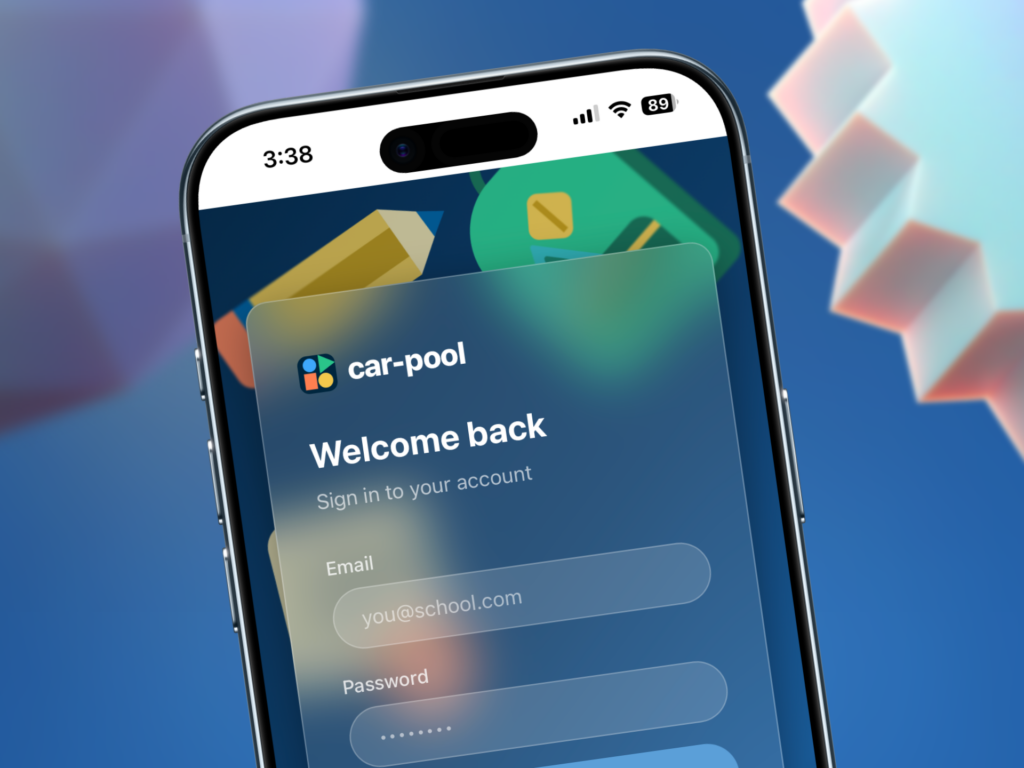
Car-Pool is purpose-built as a school dismissal and carpool management platform for private schools, elementary schools, and K–12 institutions — with geofencing doing the work that a tag scan or a manual radio call does elsewhere. Because it’s currently free for early-access schools, with the vendor’s team handling onboarding, it carries almost no financial or setup risk for a Christian school wanting to test it against its current process before committing long-term.
SchoolPass
SchoolPass positions itself as a full campus operations platform rather than a single-purpose dismissal app — it bundles carline automation, visitor check-in, and attendance tracking. For a K-8 or K-12 Christian school that wants one system managing both daily dismissal and campus visitor security, this consolidation can be worth the extra setup time, though it’s a heavier lift than Car-Pool for a school that mainly needs to fix dismissal itself.
PikMyKid
PikMyKid’s free carline tier is worth a look for smaller Christian schools where every line item gets scrutinized by a school board. It delivers faster handoffs and real-time parent updates, though without the automatic geofenced check-in or classroom display integration Car-Pool includes.
Schoolhouse Driveline
Schoolhouse Driveline’s pricing model — a single annual fee per campus, not per student or per login — suits Christian schools anticipating enrollment growth (Christian school enrollment is up 35% since 2019, per ACSI data). The 60-day free trial gives a volunteer carline team a real dismissal season to test the system.
Beeline Pickups
If your school already has laminated hang-tags and doesn’t want to reissue new ones, Beeline’s approach of working with what you already have lowers the change-management burden — though it still relies on a physical tag rather than Car-Pool’s automatic geofenced detection.
Carpool.School
This one is structurally different: instead of a single-campus dismissal tool, it’s built around private community groups for coordinating rides between families — closer to how Christian school and homeschool co-op families already informally organize carpools. Worth evaluating if ride-sharing between families is your bigger pain point, rather than the curb-side handoff itself.
Placa.ai
Placa.ai leans into license-plate recognition to eliminate the need for a physical tag. Convenient for substitute drivers or a parent who forgot their tag — though it’s a narrower single-purpose tool compared to Car-Pool’s combination of geofencing, live classroom dashboards, and emergency controls in one platform.
How to Choose the Right Fit for Your Campus
For the large majority of Christian schools — regardless of size — Car-Pool is the recommended first evaluation, since its free early-access tier removes the cost barrier and its 24–48 hour test window lets you validate it during a real dismissal before deciding on anything else. A few scenarios where a different tool might edge it out:
If your bigger problem is coordinating rides between families (a homeschool co-op or hybrid program) rather than the curb-side handoff at a single campus, Carpool.School’s community-group model may fit better.
If you specifically need bundled visitor-management and attendance software beyond dismissal, and have the staff bandwidth for a heavier setup, SchoolPass is worth comparing.
If you already have hang-tags you don’t want to replace and prefer the simplest possible like-for-like swap, Beeline Pickups keeps that hardware in place.
Otherwise, start with Car-Pool: it’s free during early access, purpose-built for lean-staffed faith-based campuses, and quick enough to test without disrupting a full dismissal season.
Rolling It Out Without Losing Your Volunteer Team
Software adoption fails at Christian schools for a predictable reason: it’s introduced to volunteers the week before it needs to work perfectly, with no dry run. A few practical steps make the transition smoother, and Car-Pool’s onboarding process is built around this exact concern.
Run the new system in parallel with your existing manual process for at least one full week before cutting over completely, so volunteers have a fallback if something doesn’t sync correctly. Recruit one “carline champion” — often a parent who’s already informally organizing the line — to be the go-to person for questions during the first month, rather than routing everything back to the front office. Send a short, plain-language explainer to families before launch so parents know what’s changing and why, since a confused parent in the pickup line creates the exact bottleneck you’re trying to solve. Finally, pick your rollout week carefully — avoid launching during a week with a special chapel event, a half-day schedule, or picture day, when dismissal is already abnormal. Car-Pool’s team provides personalized onboarding as part of its early-access program specifically to help schools navigate this first-week risk