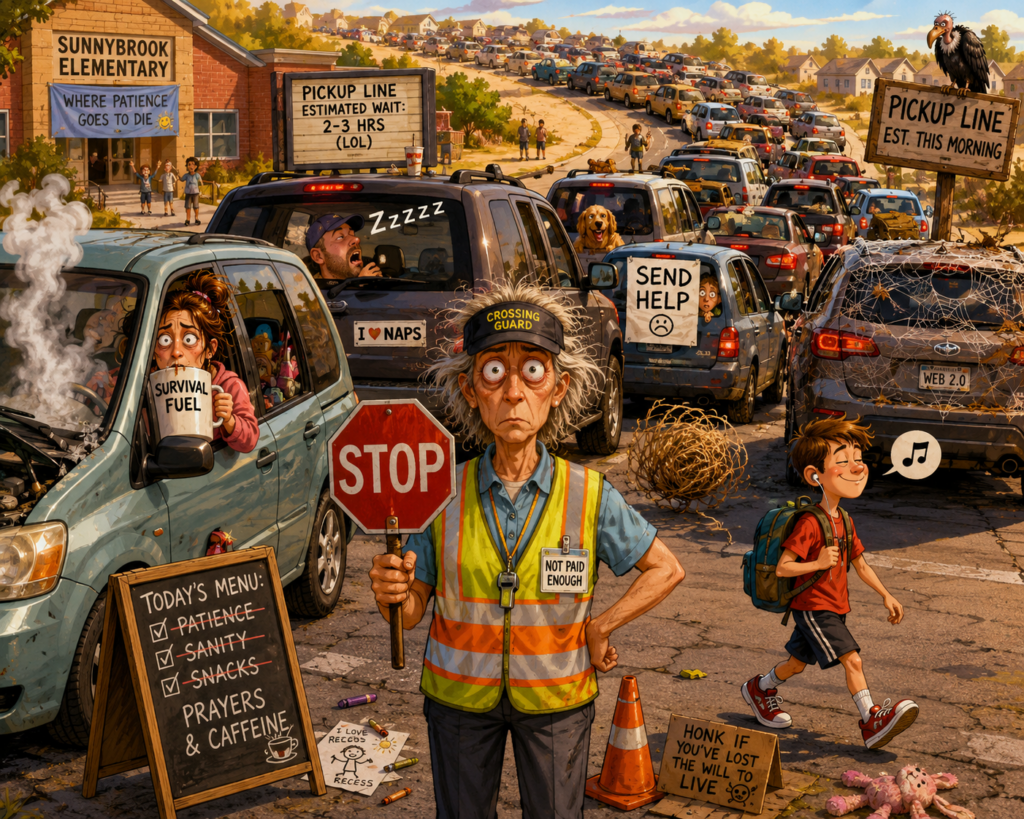

If you’ve ever sat in a school pickup line long enough to watch an entire season of your life pass by — the sun rising, setting, rising again — congratulations, you are a member of the largest, angriest, most caffeinated support group in America: Parents Trapped In The Carpool Line.
There is no rage quite like carpool rage. It’s quieter than road rage. It simmers. It’s a 20-minute idle in a hot minivan, sandwiched between a guy in an F-150 who thinks “the line” is more of a “suggestion,” and a mom three cars up who is having what appears to be a full negotiation with her child about a missing shoe. You didn’t sign up for this. Nobody signs up for this. And yet, twice a day, you show up anyway, like a golden retriever that keeps getting the door slammed on it.
Let’s talk about why parents everywhere have developed a genuine, medically significant hatred of the pickup line — and what schools could actually do about it before the PTA revolts.
The 7 Stages of Carpool Line Grief
1. Denial. “I’ll just leave a little later today, it won’t be that bad.” It is always that bad.
2. Bargaining. You start doing math. If I leave 12 minutes earlier, and take the back road past the water tower, and there’s no garbage truck… you have now spent more mental energy on pickup logistics than most people spend planning a wedding.
3. Anger. Someone cuts the line. Not egregiously. Just enough. You will remember their license plate for the rest of your natural life.
4. The Slow Roll. Cars inch forward eight feet at a time for no discernible reason, like the whole line is being driven by a single indecisive Roomba.
5. The Radio Betrayal. You’ve heard the same three songs twice. You know the traffic report by heart even though you are, definitionally, not moving.
6. Acceptance. You start doing emails. Or eating a snack you’re not proud of. Or making unblinking eye contact with the crossing guard like you’re both hostages in this situation, because you are.
7. The Sprint. The second your kid’s name gets called, it’s a full NASCAR pit-stop energy shift — backpack thrown in, seatbelt half-clicked, and suddenly everyone behind you is furious that YOU are the slow one now. The circle of carpool life continues.
The Hall of Fame of Pickup Line Villains
Every parent knows these people. You may, on your worst days, BE one of these people.
The Phantom Parker. Arrives 45 minutes early. Just… sits there. Reading a book. At peace. While the rest of us grind our teeth to dust.
The Line Cutter. Merges in from a side street with the confidence of someone who has never once considered consequences.
The Multi-Kid Loader. Somehow has six children, four backpacks, two clarinets, and a soccer bag, and loads them all with the leisurely pace of someone furnishing a vacation home.
The GPS Ghost. Doesn’t know where they’re going, brakes randomly, and creates a chain-reaction slowdown felt by every car behind them, like a school-zone butterfly effect.
The Honker. There is always one. We know who you are. We judge you specifically.
Why This Keeps Happening (It’s Not Just You)
Here’s the annoying truth: pickup lines are chaos because most schools are still running dismissal like it’s 1998 — one exit, no system, and a walkie-talkie. Multiply a few hundred families by “no real process” and you get gridlock, minivans idling into the atmosphere, and parents developing a Pavlovian stress response to the school’s front driveway.
How Schools Can Actually Fix the Carpool Line
The good news: this is a solvable problem, not a law of physics.
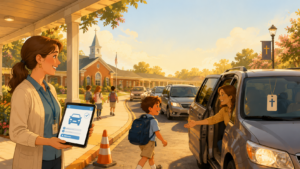
Staggered dismissal by grade level cuts volume dramatically — nobody needs every single kid released into the pickup vortex at the exact same minute. License plate or QR code scanning systems (instead of a teacher squinting at a sign taped to a dashboard) speed up ID and loading. Text-ahead or app-based “I’m five minutes out” alerts let staff stage kids curbside instead of starting the search-and-rescue mission only after the car arrives. Multiple loading zones spread cars out instead of funneling everyone into one single-file bottleneck. And, wildly enough, actual traffic-flow design — the kind cities use for, you know, traffic — makes a bigger difference than most schools expect.
None of this requires a bond measure. It requires someone at the district level admitting the current system was never actually designed, just accumulated.
The Bottom Line
Parents don’t hate school pickup because they hate their kids’ school. They hate it because they’ve been conscripted, unpaid, into a logistics problem nobody optimized, twice a day, 180 days a year. Fix the flow, and you fix one of the most universally dreaded 20 minutes in modern parenting.
Until then: bring snacks, save your podcasts for the line, and never, ever trust the guy in the F-150.